


Industries come and go. Technologies disrupt established ways of doing things. Entire business models collapse, and AI is making all of that happen faster, as you will have read approximately everywhere. Yet every disruptor, every new venture, still needs people selling, marketing, looking after customers, counting the money, hiring and training, running the IT, managing projects and leading teams. Somebody still has to decide what to sell, to whom, and answer for whether it worked.
Those are the eight business functions every organisation needs. In a two-person start-up, the same person who writes the pitch deck is also chasing the invoices and fixing the website. A multinational corporation has a department for each function full of specialists. The eight:
• Sales
• Marketing
• Customer Support
• Finance
• HR and Training
• IT
• Project Management
• Team Leadership
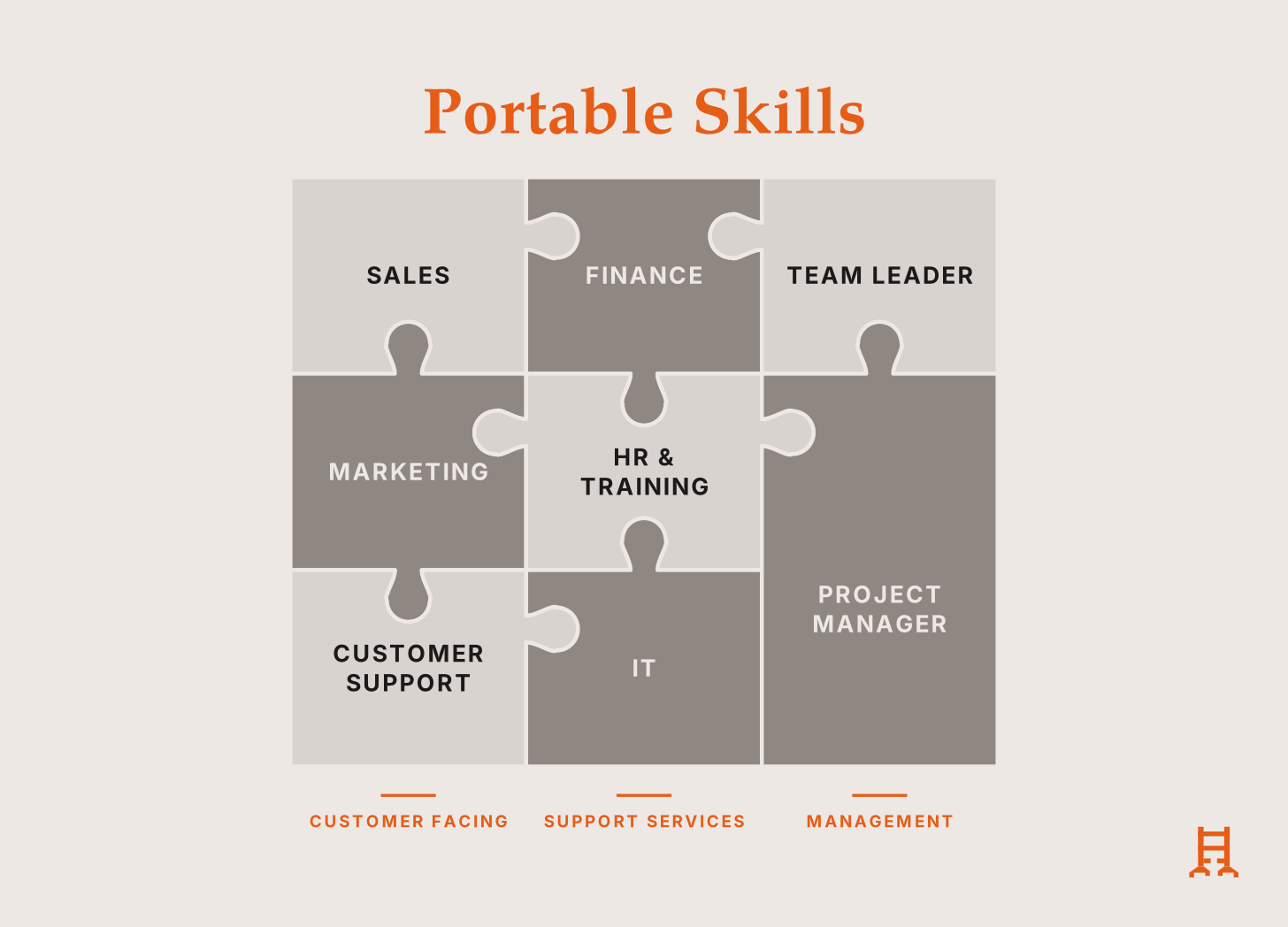
I call them Portable Skills, because they can travel with you1. They are everything that isn’t product- or industry-specific, and that is exactly why they are portable. Get good at one of them and you are employable in any industry, at any age, in any economy.
Portable Skills are the durable architecture of work: the structural walls stay put but get painted a different colour. By framing employability in terms of industries rather than Portable Skills, young people are exposed to every swing of sectoral churn, at exactly the moment the swings are getting bigger.
I’ve spent some years now working with young people, many of whose futures the system has already started to close down, prematurely in my view, because they have real potential. Holding people back to retake GCSE Maths is a case in point. More than a thousand young people have now been through a short online unit on Portable Skills with my skills training business.
They rated their strengths and weaknesses across the eight Portable Skills and named their strongest. For the learners it was eye-opening. Nobody had told them before.
Here is the puzzle. Everyone in skills education agrees that employability matters. Yet almost nobody teaches Portable Skills. What gets taught instead is “soft skills”: communication, teamwork, problem-solving, resilience. The sector has been talking about soft skills for thirty years without employers feeling noticeably better served. For nearly twenty of those years the CBI’s employer surveys reported two thirds of employers dissatisfied with school leavers’ “business and customer awareness”22, and in all that time nobody has written a curriculum for it.
What’s wrong with soft skills
Nothing, as far as they go. The trouble is you can’t prove them and many people find them too woolly. “I’m a good communicator” is a claim that employers have learned to ignore. Learners are told to develop communication skills, but often don’t know specifically how to improve. The same goes for time management: everyone agrees it matters, and almost no one can say what getting better at it involves.
Now swap the frame. Instead of “I’m curious”, a learner builds a spreadsheet that models a small business’s profit and loss and recommends where to save money. Now that’s something every employer understands.
Why the sector misses Portable Skills
Four reasons, I think.
• Who writes the frameworks. Employability frameworks are mostly written by professional educators, and this is no criticism of them, but 82 per cent of jobs in the UK are in the private sector 33. The eight Portable Skills are not what a working life in education is organised around.
• Terminology lock-in. Policy and funding bodies talk about “soft skills” and “transferable skills”. Colleges mirror that language, because it is the language they are funded in. Employers use it too, but find it too vague to hire on.
• The system certifies inputs. Qualifications certify what you know and what you can do, not the value you can deliver to someone else. A unit on “communication” fits that system neatly. A unit on “can this person run the customer-support inbox for a week and make good decisions” does not. So the system has quietly selected the thing it can assess rather than the thing employers need.
• Sectoral slicing. Where employers do get a seat at the table, in apprenticeship standards, their brief is to defend their own sector. That is fine, but it means the world of work is sliced into more than seven hundred apprenticeship standards (Germany manages with under five hundred), 44 and a seventeen-year-old is asked to pick one. Most freeze. Eight Portable Skills is a list a person can actually get their head around.
The wrong question
The sector has been asking the wrong question.
• Sectoral lens: “Which industry will this learner work in?”
• Portable Skills lens: “What will this learner be able to do for any employer?”
The first is a gamble; industries rise and fall. The second is insurance; the eight Portable Skills are always needed.
A Portable Skills checklist isn’t polite: it might say “you’d be good at finance and mediocre at sales”, and the sector is not comfortable saying that to a seventeen-year-old. It should be. It’s the most useful thing anyone told me at that age.
The checklist I use for assessing Portable Skills is free for non-commercial use; it’s in the Frameworks menu, at the top of the page. If you run a college or employment programme and you think it is useful, please subscribe and download it.
Notes
[AMBS / Jaffa Foundation origin citation: to be supplied by David; see note below.]
CBI Education and Skills Survey 2017, employers dissatisfied with school and college leavers’ business and customer awareness: 68% (2010), 69% (2011), 69% (2012), 66% (2015), 69% (2016), 62% (2017). The series began in 2008.
ONS, Public sector employment, UK: June 2026 (released 15 September 2026).
Gatsby Foundation, Evolution not Revolution: a way forward for apprenticeships (May 2026): 717 live apprenticeship standards in England (722 approved for delivery at end 2025); Germany 482, Switzerland 403, Denmark 234. Apprenticeship standards have been the responsibility of Skills England since 2 June 2025: https://www.gov.uk/government/publications/skills-england-annual-report-and-accounts-2025-to-2026/skills-england-annual-report-and-accounts-2026