


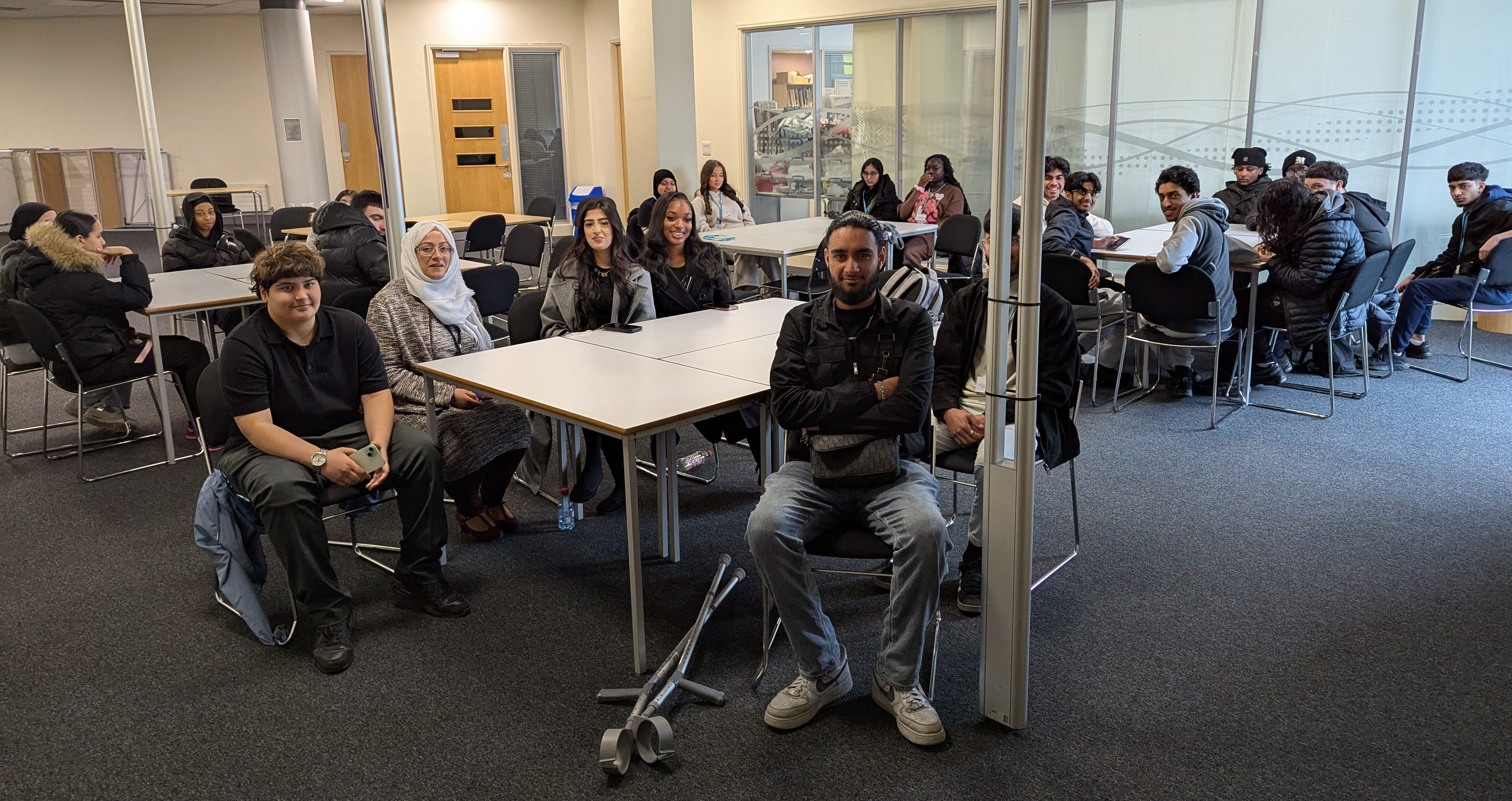
England’s 38 Local Skills Improvement Plans, written between 2023 and 2025, asked employers about the skills gaps in their local area. They keep naming soft skills and work-readiness, especially in young people.1 So, I want to share my experience from the field delivering work-readiness programmes including soft skills to young people in different settings.
It’s tempting, when thinking about preparing young people for work, to treat them as one group. But they aren’t. The 17-year-old on a two-year BTEC, one resitting GCSE maths for the third time, a sixth-former with a university offer and a NEET 22-year-old referred by a Jobcentre want different things from a work-readiness programme and respond differently to the content.
This is a practitioner’s map of those groups, drawn from six years of designing and delivering programmes and qualifications in essential work skills, much of it in the room as well as online.
The extent and limits of my experience
Set out below is my experience at the time of writing, October 2026, so you can judge what transfers to your own context. You may have more experience than me in your area of specialism.
I have taught work-readiness and entrepreneurship face to face in five schools in north-west London and Tower Hamlets, including a day a week for two years at a Tower Hamlets school with two cohorts of BTEC students aged 16 to 17.
Working with a team, we created online units from the material previously delivered face to face. This was quality assured and endorsed by an awarding body as a Level 3 Award in Essential Work Skills, and since extended to Levels 1 and 2. I watched the online version being delivered in seven FE colleges and one sixth form college in England and one college in Wales, mostly with Level 2 and Level 3 vocational learners and less often with A level students and adult learners.2 This included a complex implementation at one FE college across four campuses, with 371 learners and 17 college tutors delivering the programme in 13 subject areas.3 I spent four years working on the delivery and support model that sits behind the online units. I have worked with one NEET group: eight young adults aged 19 to 24, referred through a Jobcentre in Somerset.
My Level 1 experience is thin, as is my experience in higher education. I have no experience with NEET groups aged over 25, which a prime contractor bidding for employment-support work asked me about recently; I had to say no.
The programme materials (described for context) are short units of three to eight hours in financial literacy, public speaking, developing a winning mentality, entrepreneurship, mandatory topics such as Prevent, consent and fundamental British values, and something we call Portable Skills. Portable Skills are the eight business functions that exist in every commercial organisation: sales, marketing, customer support, finance, HR and training, IT, project management and team leadership. Learners explore which of the eight is a good fit for them, and how those functions fit together in an organisation. The units make up the Level 1 to 3 Awards I designed, so that is my interest, on the table.
What follows is the settings I have worked in, the groups inside each, and how they respond to work-readiness provision of this type.
Further education
For readers who came up through sixth form and university, a word on FE, because in England roughly half of 16 and 17-year-olds in education are at an FE college or sixth form college.4 A general FE college teaches a wide range of vocational qualifications including business, IT and cybersecurity, media and games design, health and social care, education and early years, construction and the trades, art and design, sports, hospitality and catering, and travel and tourism, cabin crew included. Many also teach some A levels. The vocational qualifications are BTECs and T Levels, with changes on the way. FE also contains two things school sixth forms barely do: whole Level 2 and Level 1 cohorts, on their own courses with their own timetables.5
Level 3
Level 3 learners are typically on a two-year BTEC or T Level. As a group they are bright, keen and confident, and they know where they are going: most into work, some into apprenticeships (hard to get), some stay in college and take Level 4 or 5 courses in their field, and some go on to university. An education and early years group I met in Essex (all girls) could tell me their future route in detail: which course next, how many years, whether nursery or primary school, special needs or mainstream. Level 3 learners are willing to complete online learning partly in their own time. They relish being given a degree of independence and colleges encourage this too. Of the groups I have worked with, Level 3 learners at FE need the least support from the delivery.
What Level 3 learners need from provision: stretch and relevance. They like the material to provide challenge. They need to see specifically how the content will help them be successful in their future career. The message that employers want ‘soft skills’ is too generic to be credible for them.
Level 2
Level 2 is typically a one-year course, and the group is defined less by what they study than by what they don’t have: a grade 4 in GCSE maths or English, usually maths. The year includes a resit, which is compulsory, demoralising and, for more than four in five of them, unsuccessful.6 The Level 2 plumbing group I met in Essex (almost all boys) was a different picture from the Level 3 education and early years girls described above: several had chosen plumbing as a best guess, and their route beyond the course was hazy.
It’s interesting to see what happens when a Level 2 group meets a spreadsheet for the first time in the financial literacy unit, the hardest unit, of our programme. A typical task is a personal budget in a spreadsheet: income at the top, outgoings below, a total at the bottom. Very few of our learners (10 to 15%) have ever used a spreadsheet before. In the first lesson, maybe two or three learners in a Level 2 group of 15 or 18 need support from their tutor. The tutor goes round, one-to-one, pointing at cells. Change the green cell, watch the yellow total move, cut the cost of takeaways, see what happens at the end of the month. The learners get it, and start working on the scenario. They don’t think of it as maths. To them, it’s just an ordinary task in a lesson. And in the next lesson involving a spreadsheet task, they don’t need tutor support.
It makes me feel disappointed that we’re holding young people back who didn’t get a grade 4 in GCSE maths. I have written about this elsewhere.7
An employability coach at a London college didn’t tell her Level 2 learners that the award they were taking was a Level 3 award until they had finished it: “They can feel so frightened when they hear ‘Level 3’ and I don’t want to put them off.” They passed it. At Level 3. The label frightened them more than the content did. It’s worth saying that nothing a plumber or a teaching assistant does all day needs GCSE maths as such. The GCSE maths ‘gate’ is in the entry requirement, not the job. And I’m glad they can now use a spreadsheet.
What Level 2 learners need from provision: a tutor in the room, and broadly the same content as Level 3, but with more support from delivery. In my experience, they are much more capable than many people think. I’d question whether the Level 2 label is helping them.
Level 1
My experience at Level 1 is thinner, so weigh this accordingly. The groups I have seen include a higher proportion of learners with special educational needs, and the surprise, for me, is they are more able than I expected. Level 1 learners can access the content but have a harder time staying on task. Some of them struggle to regulate themselves in a room. Level 1 groups need more staff per learner than Level 2 or Level 3 groups. Lots of emotional support and one-to-one time. Colleges know it, which is why these groups get the most supervision on the timetable.
What Level 1 learners need from provision: classroom management and emotional support. The content itself needs some simplifying, but less than I expected. Again, these young people are capable of more than many people think.
A level
A level learners presented similarly whether at FE college or secondary school. They are harder to engage in skills content than learners on vocational pathways, and it is not a lack of ability. They are strong on cognitive skills, which is why they are doing A levels, and that gives them an advantage in learning practical skills too: they pick the content up fast and do it well. What they lack is a reason to engage in it. They are focused on going to university. In their minds, university is the golden ticket, and anything about skills for work feels like it belongs to a later chapter.
I also see a bias against practical skills among A level students, who may see them as lower value or status than academics. Maybe it is the legacy of ‘working with your mind’ being seen as more valuable and higher status than ‘working with your hands’. The sixth form group I worked with most completed the programme and did well, but needed more pushing and different hooks than the vocational groups I have worked with.
What A level students need from provision: the content itself they handle very well. Colleges and schools need to ensure A level students can see the value of spending time on careers and practical skills qualifications, which isn’t obvious to them. And it wouldn’t hurt if such qualifications were able to attract UCAS points.
Secondary schools
Secondary schools use our programmes with Year 10s and Year 12s, and sometimes Year 9s. Rarely Year 11s or Year 13s. Schools see the value in careers programming, and often have aspirational straplines saying so, but under pressure on exam results they limit curriculum time in an exam year (GCSE and A level) to things that count directly towards exam results.
University
I spent an evening with about 20 undergraduates at my old Cambridge college and found them similar to the A level groups, if anything more so: more convinced that a Cambridge degree is the golden ticket, less inclined to see the point of practical skills, dismissive even, notwithstanding they are closer to the workplace than sixth formers.
This was me, of course, 40 years ago, and it’s surprising how little has changed. I came through a good school, A levels and university, but arrived in the workplace underprepared in practical skills. Many people I talk to outside education feel the same disconnect: that the education system doesn’t do well enough at giving people the practical, non-academic skills to succeed at work and in life. That disconnect is getting bigger as AI hollows out the early rungs of the career ladder where graduates used to learn practical skills on the job.8
NEET aged 19 to 24
My NEET experience is one group of eight, aged 19 to 24, referred by a Jobcentre in Somerset, so this is a small sample. The circumstances in the room correlated strongly with the public reports: care leavers, neurodiversity, a dropped apprenticeship, caring responsibilities at home, severe anxiety, very low prior attainment.9[9] I had met all of those circumstances previously at FE, so none of them was new to me. The main difference was that there were Level 1, 2 and 3 participants all within the same group, and we needed to modify delivery to accommodate that range.
None of that changed how the learners related to the content itself.
The surprise for me was that the participants wanted to work; what they lacked was a practical way into a job that suited their strengths and interests, and where they could see themselves succeeding. They kept turning up every week, which for that group is significant. The first thing we did was ask what they were good at within the eight Portable Skills, with a checklist to help. Participants who arrived believing they had little to offer were naming roles they wanted to pursue within the first session.
From the Jobcentre side there was a higher level of support than in other settings: two to three staff for eight participants. This was appropriate and needed and is clearly an expensive model. The staff had a strong one-to-one relationship with individual participants. They believe the young people are capable of anything they set their mind to. And the young people respond accordingly, which suggests they are probably right.
What NEET participants aged 19 to 24 need from provision: a facilitator who believes in them, a spread of Level 1, 2 and 3 content that helps them identify existing strengths and interests within things that are needed in the workplace and which they may not have previously considered, and practical next steps into a job.
Content differences
A few things I learned about the content, as opposed to the learners.
Academic content versus practical skills content
In an earlier edtech business I wrote and commissioned online revision content for GCSE subjects. When I came to design practical skills content, the difference was dramatic: practical skills need several times less content than an academic subject. That is interesting for the system, because it implies that teaching practical skills at scale is a much easier problem than is generally assumed, provided they are kept as a subject in their own right rather than embedded across the curriculum. Online turns out to be a good medium for teaching topics where the expertise may not be in the room. There is a lot more to say about this, but that is for another post.
Financial literacy
Using spreadsheets is a gateway skill within financial literacy. Very few learners, at any level, had used a spreadsheet before, and I suspect that is true of most school leavers and a good many graduates. Three or four in 20 need help the first time they use a spreadsheet but get over it in one lesson. There is a big spread in aptitude, however, in understanding what the numbers say and what to change for a better outcome: the same budgeting task takes one learner two or three minutes and another needs help to finished after 40. The spread in aptitude doesn’t correlate with Level as much as you might think. And appears to be separate from ‘maths’ skills.
Public speaking
Comfort with public speaking varies enormously; ability varies much less, and tracks neither level nor the introvert and extrovert split. The boy who is mortified to stand up can be compelling on a subject he knows. Our unit is based on the Toastmasters philosophy that public speaking is mostly about practice: how many times you have done it. That has been my experience delivering our programme.
Portable Skills
Nobody I worked with had been told previously how work is organised: the eight business functions that every commercial organisation must do (sales, marketing, customer support, finance, HR and training, IT, project management and team leadership), or where their strengths lie within them. It’s a very good thing for young people to know early in their career. We needed to contextualise this content for learners on vocational pathways according to subject area, so learners could see the relevance to their chosen vocation.
Staffing considerations
Across every setting I have worked in, FE, schools and the Jobcentre, I have met tutors and facilitators who love the kids and build strong relationships with them. Young people respond to that: they step up, stretch themselves and enjoy the process. What those tutors often lack is a curriculum to work from, so the information young people are given about the workplace is inconsistent. A consistent, expert-written curriculum would let those tutors do the part they are good at.
In conclusion
Looking back across the groups, the content needed didn’t change much. What changed was the support: very little at Level 3, a tutor in the room at Level 2, more staff per learner at Level 1, two or three staff for eight at the Jobcentre. If I were designing provision for a region, that is the variable I would plan and cost by group, and I would expect the money to run the opposite way to the numbers: most learners in the cheapest-to-serve groups, most cost in the smallest.
That is the field guide. I hope it helps you navigate provision in your context. If your patch looks different, I would like to hear it; you may have more groups of learners behind you than I do.
Notes
Department for Education, AI analysis of local skills improvement plans (November 2023), covering all 38 LSIPs; British Chambers of Commerce, LSIPs Evaluation Report (February 2024): “employers, time and time again, cited the importance of cross-sectoral ‘soft’ skills”, often above technical skills; Association of Colleges, Local skills improvement plans: a review of their impact (June 2024). The first LSIP cycle ran from August 2023 to March 2025; the second cycle is now in force.
London, Essex, East Sussex, Birmingham, Lincolnshire and Wales. I have also run sessions with teenagers at private schools in London and in Atlanta, Georgia, including a four-day half-term camp at a school in north-west London.
At South Essex College in academic year 2025 to 2026, 17 college tutors delivered the programme to 371 learners in 26 teaching groups across four campuses, in 13 subject areas: digital and IT, games development and animation, engineering and mechatronics, accountancy, business, education and early years, health and social care, dance, policing, A level, professional cookery, Level 2 electrical, and travel and tourism. Average completion 92%; 82% (303 learners out of 371) achieved the Award in Essential Work Skills at Level 2 or Level 3 (college snapshot, 25 June 2026).
DfE, Participation in education, training and employment age 16 to 18, institution type at academic age 16 to 17, end 2023: state-funded schools 35.9% of the age group, independent schools 6.3%, sixth form colleges 7.4%, general FE, tertiary and specialist colleges 34.6%, special schools 1.1%; 86.1% in education overall. The series was replaced in June 2026 by Participation in education, training and employment age 16 to 21, which revises earlier years slightly.
Rebecca Allen, Meenakshi Parameshwaran and Dave Thomson (Education Datalab) for the Social Mobility Commission, Social and ethnic inequalities in choice available and choices made at age 16 (December 2016), Figure 2, page 13: at 16, 48% of FE college students were studying Level 2 qualifications, against 7% in state school sixth forms and 9% in sixth form colleges. DfE’s participation statistics put Level 2 as the highest aim for 16.5% of all 16 to 17-year-olds in 2024 and Level 1 for 2.1%.
JCQ, Post-16 GCSE results for English and mathematics by age and sex, England, summer 2026 (Table 5): 15.3% of 219,135 maths entries from students aged 17 and over achieved grade 4 or above, against 17.1% in 2025 and 21.2% in 2019. The rate at ages 18 and 19 is about 10%. The Department for Education described the resit system as “demoralising” on results day.
Alan Milburn, Young people and work: interim report (Independent review of youth economic inactivity for the Department for Work and Pensions, May 2026; updated August 2026). The report sets out the circumstances of the NEET population, finds that 84% want to be in work or training, and states that “the first rungs on the old career ladder have weakened”.